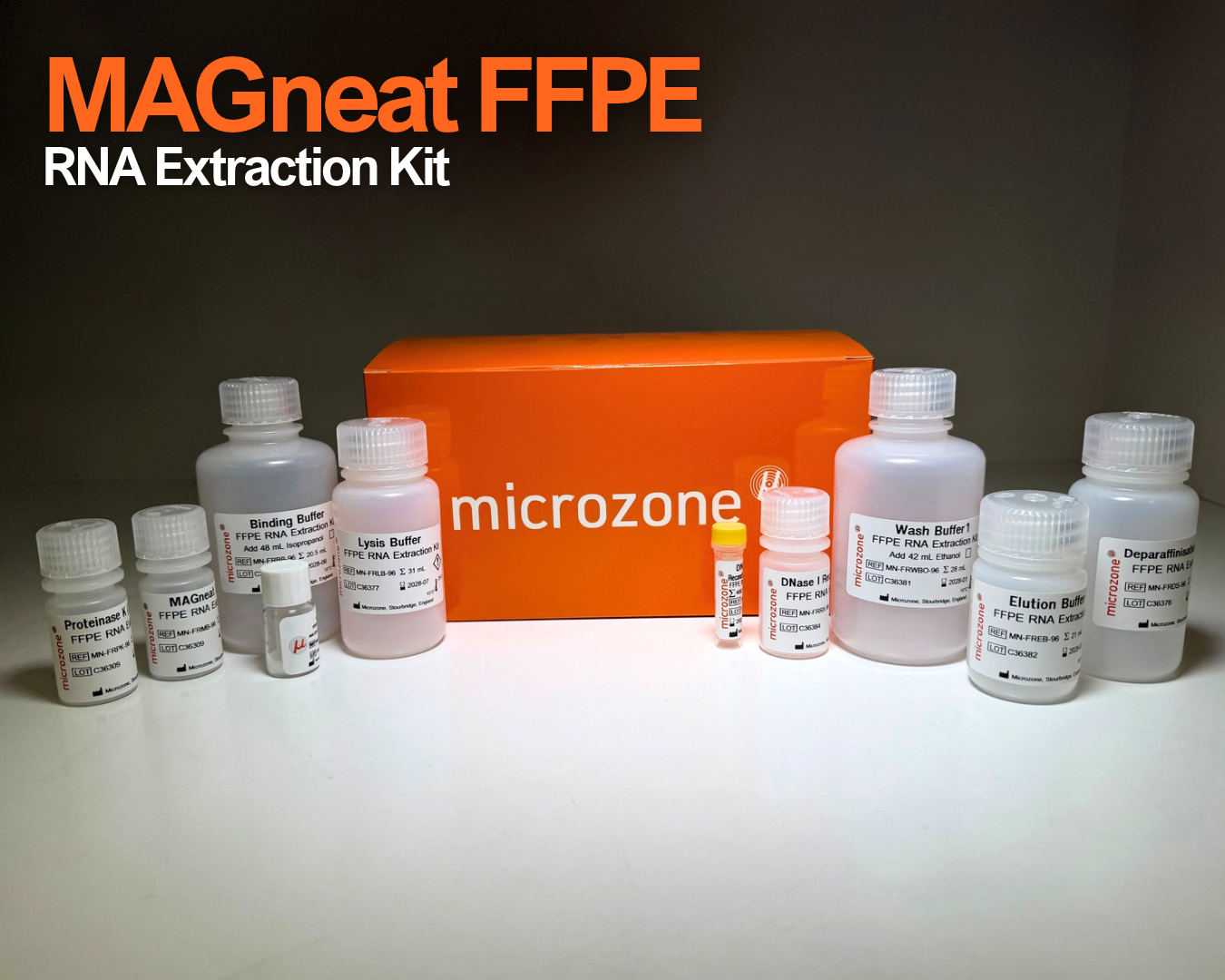
MAGneat FFPE RNA Extraction Kit
£475.00
Description
Extracts high molecular weight RNA from FFPE (formalin-fixed, paraffin-embedded) tissue samples. Suitable for RT-PCR, RT-qPCR, NGS, Sanger Sequencing, mutation and biomarker analysis, SNP genotyping, cancer and translational research and retrospective studies using archived tissue sample
Overview of kit:
MAGneat FFPE RNA Extraction Kit is a magnetic bead-based RNA extraction kit designed for rapid purification of high-quality RNA FFPE (formalin-fixed, paraffin-embedded) tissue samples. Ready for RT-PCR, RT-qPCR, NGS, Sanger sequencing, cancer research, biomarker analysis and other molecular biology applications.
Principle of kit summary:
The MAGneat FFPE RNA Extraction Kit uses magnetic bead technology to isolate and purify RNA from formalin-fixed, paraffin-embedded (FFPE) tissue samples. Following tissue lysis and Proteinase K digestion, optimised buffer chemistry helps recover RNA by reversing formaldehyde-induced crosslinks. The released RNA selectively binds to magnetic beads, allowing contaminants to be removed through a series of wash steps before the purified RNA is eluted in a low-salt buffer. The resulting RNA is suitable for a wide range of downstream molecular applications, including RT-PCR, RT-qPCR, sequencing, and NGS workflows.
Additional information
| FFPE RNA | 96 reactions |
|---|
Extracts high molecular weight RNA from FFPE (formalin-fixed, paraffin-embedded) tissue samples. Suitable for RT-PCR, RT-qPCR, NGS, Sanger Sequencing, mutation and biomarker analysis, SNP genotyping, cancer and translational research and retrospective studies using archived tissue sample
Overview of kit:
MAGneat FFPE RNA Extraction Kit is a magnetic bead-based RNA extraction kit designed for rapid purification of high-quality RNA FFPE (formalin-fixed, paraffin-embedded) tissue samples. Ready for RT-PCR, RT-qPCR, NGS, Sanger sequencing, cancer research, biomarker analysis and other molecular biology applications.
Principle of kit summary:
The MAGneat FFPE RNA Extraction Kit uses magnetic bead technology to isolate and purify RNA from formalin-fixed, paraffin-embedded (FFPE) tissue samples. Following tissue lysis and Proteinase K digestion, optimised buffer chemistry helps recover RNA by reversing formaldehyde-induced crosslinks. The released RNA selectively binds to magnetic beads, allowing contaminants to be removed through a series of wash steps before the purified RNA is eluted in a low-salt buffer. The resulting RNA is suitable for a wide range of downstream molecular applications, including RT-PCR, RT-qPCR, sequencing, and NGS workflows.
Compatible Sample Types
This kit is compatible with the following sample types:
- FFPE tissue sections
- Archived FFPE blocks
- Biopsy specimens
- Tumor tissue
- Histology Sections
Manual and Automated FFPE RNA Extraction
MAGneat FFPE RNA Extraction Kit supports both manual magnetic bead purification and automated extraction using Microzone’s HeiDi-NA system.
Manual RNA extraction
The manual protocol uses MAGneat magnetic beads and a compatible magnetic separation device. Following FFPE tissue preparation, digestion and de-crosslinking, RNA is purified through magnetic bead binding, washing, DNase I treatment and final elution.
Automated RNA extraction with HeiDi-NA
The kit includes a dedicated HeiDi-NA protocol for automated magnetic bead purification. FFPE tissue preparation, deparaffinisation, digestion and de-crosslinking are performed before the prepared sample enters the automated workflow.
The HeiDi-NA instrument run takes approximately 50 minutes and includes reagent-addition pauses. This time does not include initial FFPE sample preparation.
Both protocols produce RNA for subsequent molecular analysis.
Workflow summary:
Deparaffinisation → Tissue Digestion → Crosslink Reversal → DNase Treatment → RNA binding to magnetic beads → Washing → RNA Elution → Downstream processing.
- Designed specifically for FFPE tissue
- Efficient paraffin removal
- Magnetic bead-based technology
- Optimised crosslink reversal
- High-quality RNA recovery
- Integrated DNase I treatment
- Automation ready
- Suitable for demanding molecular applications
- Consistent and reproducible results
- Archival FFPE performance
- RT-PCR and RT-qPCR workflows
- RT-qPCR and RT-qPCR workflows
- Cancer research using preserved tissue specimens
- Molecular pathology
- Molecular pathology
- Translation research
- Translation research
- Biomarker discovery
- Mutation analysis
- NGS
- Sanger sequencing
- Genotyping
- Retrospective tissue research
- SNP Analysis
- Archival RNA tissue collections
- Research involving quantitative RNA analysis
- Gene expression analysis
- Molecular pathology research
- Product name: MAGneat FFPE RNA Extraction Kit
- Brand: Microzone
- SKU: 2MN-FFPER-96
- Description: magnetic bead-based FFPE extraction kit designed to purify high-quality, high molecular weight FFPE from FFPE (formalin-fixed, paraffin-embedded) samples suitable for downstream molecular biology applications.
- Availability: same day shipping on orders before noon.
- Price: £475.00
- Category: Extraction
- Technology: magnetic bead
- RNA type: genomic
- Automation compatible: Yes
- Sample types: FFPE tissue
- DNA removal: Integrated DNase I treatment
What is the MAGneat FFPE RNA Extraction Kit?
Answer: The MAGneat FFPE RNA Extraction Kit is a magnetic bead-based kit designed to purify RNA from formalin-fixed, paraffin-embedded (FFPE) tissue samples. The kit combines specialised deparaffinisation, Proteinase K digestion, de-crosslinking treatment, DNase I treatment and MAGneat magnetic bead purification to recover RNA suitable for downstream molecular biology applications, including RT-PCR, RT-qPCR and other RNA analysis workflows.
What are FFPE tissue samples?
Answer: FFPE stands for formalin-fixed, paraffin-embedded. FFPE tissue samples are biological specimens preserved through formalin fixation and embedding in paraffin wax. This method is widely used in pathology, cancer research and molecular research because it preserves tissue morphology and allows specimens to be archived for extended periods.
Why is RNA difficult to extract from FFPE tissue?
Answer: RNA extraction from FFPE tissue can be challenging because formalin fixation introduces chemical modifications and crosslinks that can affect RNA recovery. Tissue processing and long-term storage can also contribute to RNA fragmentation, while paraffin must be removed before effective purification. These factors can influence RNA yield, quality and performance in downstream applications such as RT-qPCR and sequencing.
How does the MAGneat FFPE RNA Extraction Kit remove paraffin?
Answer: The MAGneat FFPE RNA Extraction Kit includes a dedicated FFPE RNA Deparaffinisation Solution to remove paraffin during sample preparation. The protocol involves treating FFPE tissue sections with the solution and incubating at 56°C for 3 minutes before proceeding to tissue digestion and RNA purification. This helps prepare the preserved tissue for efficient RNA extraction.
Does the kit reverse formalin-induced crosslinks?
Answer: Yes. The MAGneat FFPE RNA Extraction Kit incorporates a de-crosslinking step designed to address formalin-induced crosslinks associated with FFPE preservation. Following Proteinase K digestion at 56°C, the protocol includes an incubation at 80°C for 15 minutes to support RNA recovery from formalin-fixed tissue.
Does the MAGneat FFPE RNA Extraction Kit use magnetic bead technology?
Answer: Yes. The MAGneat FFPE RNA Extraction Kit uses Microzone’s MAGneat magnetic bead technology to purify RNA from FFPE tissue samples. RNA binds to the magnetic beads under the specified buffer conditions, allowing magnetic separation, washing and elution. This bead-based approach supports both manual extraction and automated purification using compatible magnetic processing equipment.
Does the kit include DNase I treatment to remove genomic DNA?
Answer: Yes. The MAGneat FFPE RNA Extraction Kit includes DNase I, DNase I Reconstitution Buffer and DNase I Reaction Buffer. The extraction protocol incorporates a DNase I treatment step to reduce residual genomic DNA contamination before final RNA purification and elution. This is particularly relevant for downstream RNA analysis, including RT-qPCR and gene expression research.
What types of FFPE tissue samples are compatible with the kit?
Answer: The MAGneat FFPE RNA Extraction Kit is designed for RNA extraction from formalin-fixed, paraffin-embedded tissue sections, including archived tissue specimens. Microzone has demonstrated RNA recovery from bladder cancer and gastroesophageal cancer FFPE tissue samples. The kit’s suitability for individual tissue types may depend on fixation conditions, tissue composition, storage history and sample input.
Can RNA be extracted from archived FFPE tissue blocks?
Answer: Yes. The MAGneat FFPE RNA Extraction Kit has demonstrated RNA recovery from archival FFPE tissue blocks, including bladder cancer tissue dating from 1997 and gastroesophageal cancer tissue dating from 2008. RNA recovered from both samples was successfully amplified using GAPDH-targeted RT-qPCR, demonstrating downstream functionality in the evaluated specimens.
How much FFPE tissue is required for RNA extraction?
Answer: The MAGneat FFPE RNA Extraction Kit protocol supports FFPE tissue sections up to 20 µm thick. For first-time users, Microzone recommends starting with no more than three 10 µm sections to optimise extraction performance. In Microzone’s archival FFPE RNA evaluation, two 10 µm tissue sections were used per extraction.
What RNA yield can be obtained from FFPE tissue using the kit?
Answer: RNA yield depends on tissue type, fixation conditions, storage history and sample input. In Microzone’s performance evaluation, the MAGneat FFPE RNA Extraction Kit recovered 20.4 µg of RNA from bladder cancer FFPE tissue dating from 1997 and 15.6 µg from gastroesophageal cancer FFPE tissue dating from 2008. Both extractions used two 10 µm tissue sections, and RNA concentration was measured using Qubit fluorometric quantification.
Is RNA extracted using the MAGneat FFPE RNA Extraction Kit suitable for RT-qPCR?
Answer: Yes. RNA extracted using the MAGneat FFPE RNA Extraction Kit has been successfully amplified using GAPDH-targeted RT-qPCR. Microzone demonstrated amplification from RNA recovered from both archival bladder cancer and gastroesophageal cancer FFPE tissue samples. These results support the kit’s use in RT-qPCR workflows, subject to the requirements of the individual assay.
Can the extracted RNA be used for gene expression analysis?
Answer: The MAGneat FFPE RNA Extraction Kit is suitable for consideration in RNA-based gene expression research using FFPE tissue. Its performance has been demonstrated through GAPDH-targeted RT-qPCR amplification from archival FFPE samples. Researchers should assess RNA quality and validate their selected gene targets and assays, particularly when working with fragmented FFPE RNA.
Is the MAGneat FFPE RNA Extraction Kit suitable for next-generation sequencing (NGS)?
Answer: The MAGneat FFPE RNA Extraction Kit instructions for use identify next-generation sequencing as a downstream application for purified RNA. However, successful RNA sequencing depends on factors such as RNA fragment size, integrity, input quantity and library preparation requirements. Researchers should assess extracted RNA against the specifications of their chosen sequencing workflow.
Can the MAGneat FFPE RNA Extraction Kit be used for manual extraction?
Answer: Yes. The MAGneat FFPE RNA Extraction Kit includes a manual RNA extraction protocol using magnetic bead purification. The workflow involves FFPE tissue preparation, deparaffinisation, Proteinase K digestion, de-crosslinking, magnetic bead binding, washing, DNase I treatment and final RNA elution. A compatible magnetic separation device is required.
Is the MAGneat FFPE RNA Extraction Kit compatible with automated extraction systems?
Answer: Yes. The MAGneat FFPE RNA Extraction Kit includes a dedicated automated extraction protocol for Microzone’s HeiDi-NA magnetic bead purification system. The automated workflow processes prepared FFPE tissue lysates through magnetic bead purification, DNase I treatment, washing and elution. Initial tissue preparation, deparaffinisation, digestion and de-crosslinking are performed before automated processing.
How long does automated FFPE RNA extraction take?
Answer: The MAGneat FFPE RNA Extraction Kit automated protocol takes approximately 50 minutes on the HeiDi-NA system, including scheduled reagent-addition pauses. This refers to the automated instrument run and does not include the time required for initial FFPE tissue section preparation, deparaffinisation, Proteinase K digestion or de-crosslinking.
What is the recommended RNA elution volume?
Answer: The MAGneat FFPE RNA Extraction Kit protocol uses 100 µL of RNA Elution Buffer for the final elution step. Following purification and magnetic separation, the clear RNA-containing eluate is transferred into a clean tube for downstream molecular analysis. The instructions for use recommend storing purified RNA at −80°C.
How should the MAGneat FFPE RNA Extraction Kit be stored?
Answer: Most MAGneat FFPE RNA Extraction Kit components can be stored at room temperature. MAGneat magnetic beads should be stored at 2–8°C, while Proteinase K should be stored at −20°C. Reconstituted DNase I must also be stored at −20°C, avoiding repeated freeze–thaw cycles. Purified RNA should be stored at −80°C according to the instructions for use.
Why choose the MAGneat FFPE RNA Extraction Kit?
Answer: The MAGneat FFPE RNA Extraction Kit combines specialised FFPE tissue preparation, magnetic bead-based RNA purification, de-crosslinking and integrated DNase I treatment in a workflow suitable for manual or HeiDi-NA automated extraction.
The kit is supplied in a 96-extraction format and has demonstrated RNA recovery from archival FFPE tissue blocks dating from 1997 and 2008. Successful GAPDH-targeted RT-qPCR amplification from both evaluated samples provides experimental evidence of downstream functionality.
These features make the MAGneat FFPE RNA Extraction Kit a relevant solution for laboratories performing RNA extraction from FFPE tissue for molecular and cancer research.
Related products
-

MicroLYSIS PLUS RNA
2MLPR Price range: £75.00 through £1,312.00
Rapid release of RT-PCR ready RNA
-
HeiDi-NA MAGneat Nucleic Acid Extraction/ Purification System
HeiDiNA-016 £8,750.00
An ultra-compact automated extraction system occupying only 8×10 inches of bench space.
-

DNA Release Direct to PCR Genotyping Kit
2GTK Price range: £79.00 through £273.00
Genotyping kit: Fast lysis of cells and tissue, then go directly to PCR.